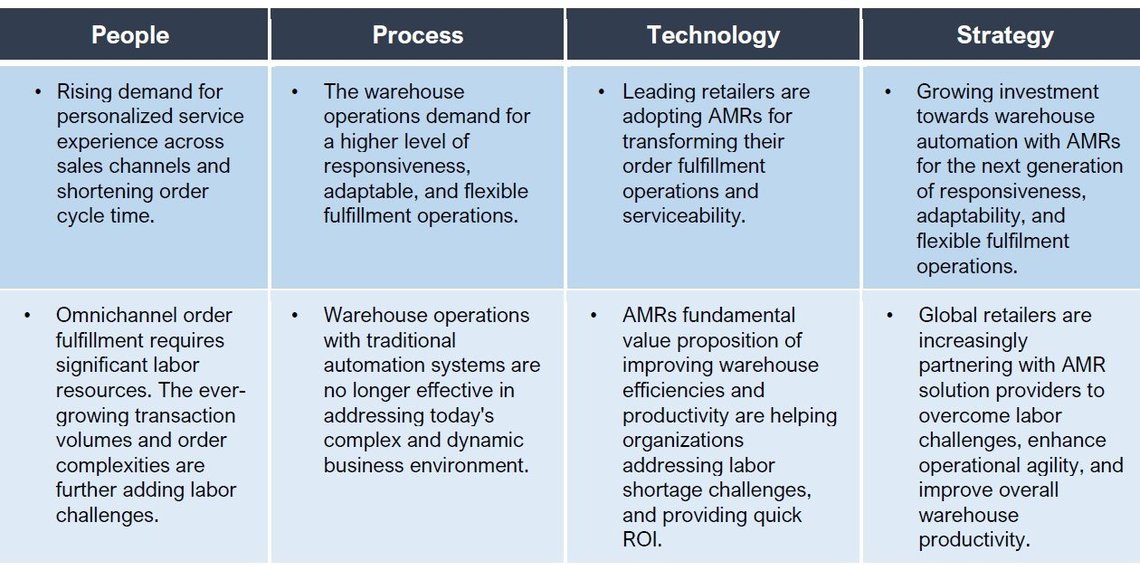
Factors such as growing e-commerce, omnichannel strategies, and rising spending capabilities are increasingly changing the meaning of customer experience across geographical regions. Beyond product price and features, the customer service experience is increasingly becoming the true differentiator for global retailers. Growing popularity of same-day or next-day delivery is further adding complexities for retailers to drive growth and improve the customer experience. Therefore, e-commerce and retail organizations are increasingly looking at building efficient, flexible, and automated supply chain processes to satisfy ever-increasing customer expectations. Adoption of warehouse automation technologies to enable faster, efficient, and dynamic order fulfilment is amongst the primary targets for automating supply chain operations.
Traditional heavier mechanized automation systems deployment was limited to large warehouses and often associated with significant upfront investments and more extended payback time. Advancements in robotics technology have led to the emergence of affordable robotics and automation systems, such as autonomous mobile robots (AMRs). These can – of course – also be combined with traditional (fixed) automation equipment that may already be in place.
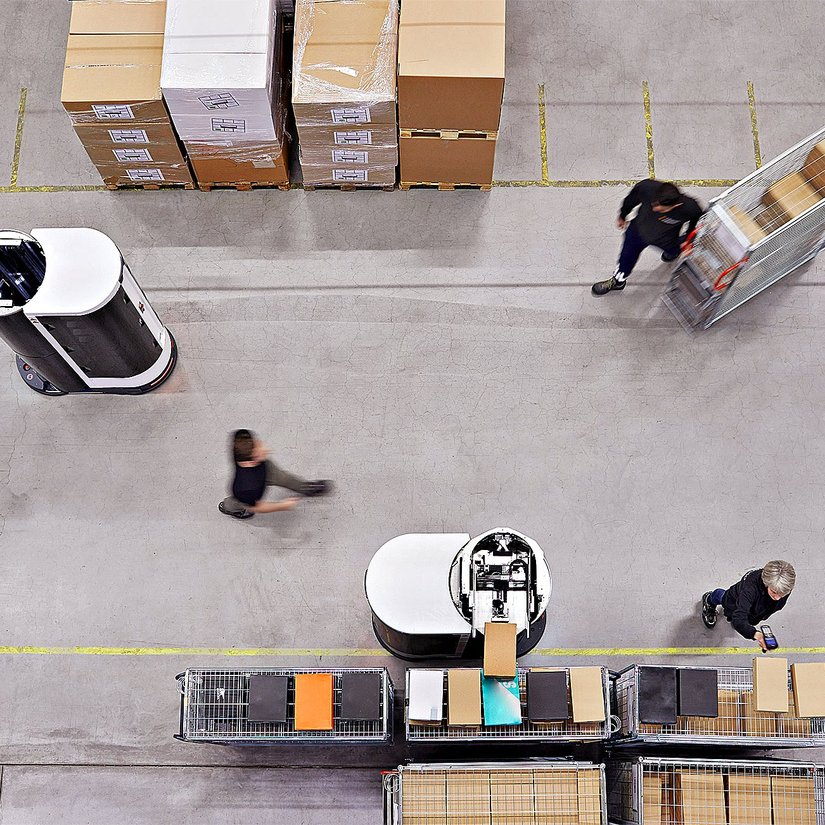
AMRs are equipped with an array of sophisticated sensors and embedded intelligence to interpret and understand their surrounding environment, navigate through various obstructions, automatically determine an optimum route to accomplish tasks and work collaboratively with operators for performing a range of operations, including order picking, sorting, and other material movements within the warehouse. AMRs may include sensors for mapping, navigation, localization, computer vision, 3D cameras, and other environmental sensors. Most AMRs use LiDAR sensors for dynamic navigation, avoiding various fixed and moving obstructions. AMR navigation within a specific warehouse environment is often achieved by building comprehensive maps either developed by the AMR itself or by uploading prebuilt warehouse maps into the AMR system.
Leading AMR vendors leverage artificial intelligence and machine learning algorithms for real-time decision-making on path optimization, improved object recognition, and enhanced collision avoidance with people and other fixed and moving objects within the operating environment. The AMR system often integrates with other mobile robots, warehouse control systems (WCS), warehouse management systems (WMS), and other warehouse execution systems for tracking, monitoring, governance, and control functions. Depending on the vendors, AMRs may also include fleet management capabilities to organize, manage, and orchestrate the movement of the fleet of AMRs to avoid collision with other vehicles, people and other objects.