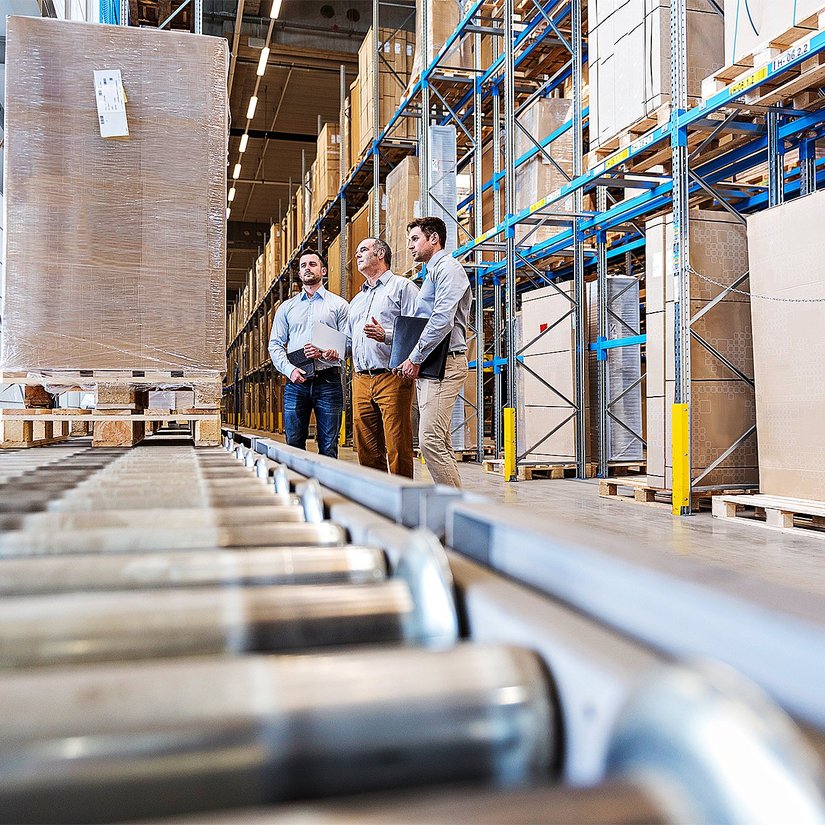
But increasing customer demands, volatile markets, and a shortage of skilled workers are pushing traditional systems to their limits. In the age of Industry 5.0, networked and efficient warehouse logistics is becoming a strategic imperative. Act now to stay ahead of competitors – future-proof your warehouse operations today.
Typical challenges for small and midsize businesses & why SAP EWM is the answer
Small and midsize businesses face unique challenges in warehouse logistics:
- Manual processes & lack of transparency: Decisions are based on gut feeling rather than real-time data.
- Lack of space & inefficient warehouse structure: Every square meter counts – but without smart control, potential remains untapped.
- Cost pressure & shortage of skilled workers: Fewer staff have to do more – automation becomes a necessity.
The main problem is often not a lack of technology, but too many manual interactions. Whether Excel spreadsheets, routing slips, or multiple data entries – every step takes time and carries the risk of input errors. These human interactions are a systematic performance brake: a wrong click or a transposed number quickly adds up to hours of rework in day-to-day business.
Why SAP EWM is the answer: Real-time data instead of gut feeling
SAP EWM creates full transparency across all warehouse movements and inventories – at any time and in real time. Companies know exactly where their goods are, how much inventory is available, and can react immediately to changes. Decisions are based on reliable data, not assumptions. This simplifies planning, reduces errors, and increases response speed – a real competitive advantage for SMBs.
Structured warehouse organization & smart control
SAP EWM allows complex warehouse layouts to be mapped precisely – including storage locations, zones, and strategies. Automated goods receipt processes and intelligent picking methods such as pick-by-light or multi-order picking further increase efficiency. Every square meter is used sensibly—making operations economical and efficient.
Automation as a strategic response
SAP EWM automates central warehouse processes – from goods receipt and picking to shipping. The integration of conveyor technology, robotics, and autonomous vehicles via material flow control (MFC) reduces manual effort and relieves the burden on staff. At the same time, the solution remains intuitive and modular – ideal for companies seeking big impact with small teams.
The myth that “SAP is too big for us”
SAP EWM used to be considered too complex, too expensive, too “enterprise.” This view is outdated. Thanks to preconfigured best practices, modular implementation scenarios, and, above all, the right consulting, even mid-sized companies can now implement a powerful SAP EWM system economically. The key to success is simplification through smartness: process automation where it creates real added value, and data collection only where it is crucial. Modern SAP EWM approaches combine intelligent process logic with semi-automated workflows – keeping the system efficient and manageable for small teams.
Looking to the future – less data, more intelligence
We are at a turning point: it is no longer the amount of data collected that determines the efficiency of a system, but its quality and interpretability. We are already investigating machine learning approaches that show that higher process quality can be achieved with less input data. Systems learn from patterns, independently recognize deviations, and support employees where human attention is really needed. This makes SAP EWM a platform for data-driven, adaptive logistics processes – and enables small and midsize businesses to benefit from future technologies.
Success starts with the right partner
Introducing SAP doesn't have to be a large-scale project. Implementation times and costs can be significantly reduced by using preconfigured templates and process-oriented standards. Körber understands the challenges faced by mid-sized companies and combines global SAP expertise with local proximity.
Understanding SAP EWM as a growth platform
SAP EWM offers mid-sized companies the opportunity to professionalize, scale, and future-proof their logistics processes. With standardized approaches, clear project methods, and an experienced partner like Körber, SAP becomes a real opportunity – not a threat.
Digitalization only delivers benefits when technology, processes, and people are in harmony. With us, you benefit from a combination of global SAP expertise, in-depth process understanding, and practical experience with medium-sized businesses.
Our methodology is pragmatic, transparent, and efficient: We think about processes from a human perspective, combining automation with simplicity – and thus implement smart, high-performance warehouse solutions that work instead of overwhelming.